Why You Shouldn't Write Blog Posts With AI (Do These Instead)
AI-written blog posts can quietly tank your SEO. Here's the real data on why, what actually grows organic traffic instead, and where AI is safe to use.
If you are reading this blog post, it is likely that you have seen all those social media posts claiming that publishing AI written blog posts helped increase organic traffic by 200% so on and so forth.
At this point, you may be wondering if writing blog posts with AI is a good idea, because after all, the social media posts you saw made you feel the hype with some screenshots of nice charts from Google Search Console showing the increase in organic traffic.
The simple answer to this question is: No, publishing AI written blog posts is not a good idea and it has never been one. The chances are those blog posts will either get you not ranked at all, or you will see some movement and eventually be penalized for it.
These days, it is now very easy to start an online business, whether launching an app or an e-commerce brand.
And, this brings a lot of people to wanting to learn and do SEO all while being overwhelmed with GEO and social media posts and tools claiming AI blog posts will do the work.
I am sorry, but it doesn't work like that. However, there are still things that you can do to help you increase your organic traffic and create a more sustainable business.
Now, let's talk about:
- Why you shouldn't write AI blog posts
- How to get more organic traffic without AI blog posts
- How you can make use of AI
Why You Shouldn't Publish AI Written Blog Posts?
There is a simple reason for this:
When you publish AI written blog posts at scale, you are doing nothing but recycling information that people can easily ask to an LLM. In other words, you are not providing value to people by contributing through your point of view, expertise, or analysis in an informational piece, and that is what's rewarded.
In the last couple of years, I have witnessed a lot of big names scaling content with AI and ranking under the radar. It was always obvious that this wasn't sustainable and wasn't worth the risk for serious businesses who depended a lot on their organic traffic.
Now we see what many of those have resulted in:
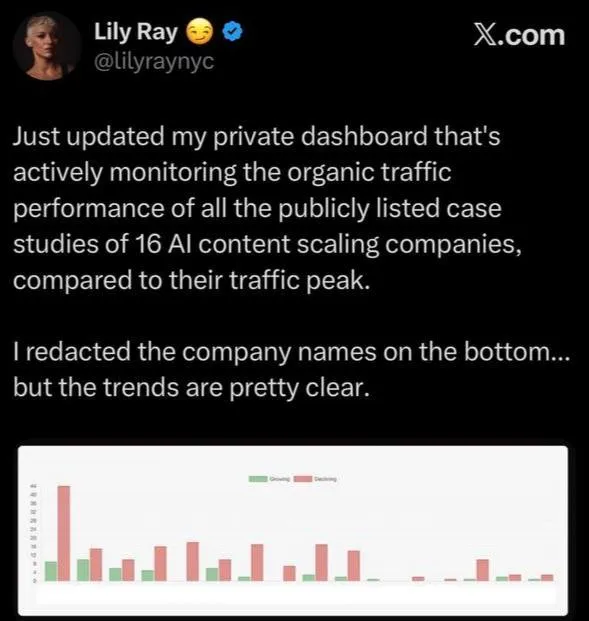 Source: Lily Ray
All these companies that have much higher authority than your new business getting penalized and bleeding traffic from AI content scaling should tell you a lot.
It is naive to think that you can create sustainable organic growth for your business by scaling content with AI.
And this isn't only an outside pattern, it is what Google itself describes. John Mueller and Martin Splitt have explained that when Search notices a pattern of thin, low-value pages, often exactly the kind of scaled AI content people rush to publish, those pages tend to sit in Crawled - currently not indexed: Google visits them, evaluates them, and then leaves them out of the index because it does not see enough original value to include. That is the "not ranked at all" outcome from the top of this post, straight from the source.
But wait, is using AI for blog posts completely bad?
No, you can still use AI in the process and it can actually help you create a better post and save a lot of time.
How to Increase Organic Traffic Without AI Blog Posts
There are many other ways to increase your organic traffic if you don't want to risk a sustainable business. I am not going to list all the best practices such as technical SEO, but I will rather talk about some practices that people overlook.
Also, I will talk about the distinction between writing blog posts with AI and how you can use AI to increase organic traffic by optimizing your non-blog pages.
Let's get into it and start with the most obvious one:
1. Write Your Own Blog Posts
A blog post talking about your experiences while building your own products will be much more valuable and sustainable than tens of AI written blog posts. It's the only kind of content that carries information nobody else has (your actual build decisions, mistakes, data), which is precisely what generic AI content can't replicate no matter how well-prompted. Our best Shopify dropshipping stores breakdown holds up for the same reason: it's a real, hands-on analysis, not a generated list.
Instead of handing the whole process to AI, you can use AI for ideation, research, grammar, and fact checking.
2. Create Social Media Content
We all know that creating social media content is great for virality and brand awareness, and it is of course another obvious choice. However, it goes deeper than that.
Your social media content eventually feeds your website's organic traffic through that brand awareness.
The brand awareness turns into direct clicks and backlinks, which later turn into organic traffic, because they are signals Google uses when ranking your content. That's why turning your products into on-brand social posts consistently pays off well beyond just engagement.
3. Digital PR & Partnerships
Digital PR and partnerships have always mattered for SEO. But there's a newer reason it matters even more now: AI answer engines don't mostly read your website, they cite third-party sources about you.
Semrush's study of 230,000 prompts and 100 million+ citations across ChatGPT, Google AI Mode, and Perplexity found Reddit, LinkedIn, and Wikipedia are consistently the most-cited domains, not brand websites.
If nobody outside your own site is talking about your brand, there's not much for an AI to cite when someone asks about your category and help build confidence. A press mention, a partner's post, a review roundup, or a Reddit thread does double duty: it's still a real SEO signal, and it's the raw material LLMs actually pull answers from. Pair it with rank tracking for ecommerce keywords so you can see whether it's actually moving your rankings.
4. Improve Your Product and Landing Pages
You should know that your product pages and landing pages are crucial for organic traffic.
Here's the part most people skip: your product pages and landing pages aren't blog posts, and the AI risk that applies to blog content doesn't apply to them the same way.
Why AI written product and landing page copy is a different category than blog posts:
A product page is structurally different from a blog post. It isn't claiming original expertise or a point of view, it's communicating facts you already know: what the product does, who it's for, how it compares, why it's worth buying.
When AI is used to organize and phrase information you (the brand) already possess and reviewed, it isn't "recycling what an LLM already knows" the way a generic "10 tips for X" post is. That's the whole distinction, and it holds for a SaaS landing page or a service business page just as much as it does for an optimized Shopify product page. The content is transactional, not informational.
A lot of people are asking questions about products and services. Creating a strong product page with product descriptions that actually rank and convert and FAQs will help you be the answer to their questions.
Here are some important statistics:
Only about half of ecommerce sites (51%) have "mediocre or worse" UX on their actual product detail pages, and 10% of sites have product descriptions that are flatly insufficient for what shoppers need to decide.
Research covering 1,910 US/UK shoppers found incomplete or poorly written titles and descriptions were the cause of 53% of abandoned carts.
That's the second-largest driver after inconsistent content across channels (54%). 71% of shoppers have returned a product because it didn't match what the page said.
Conclusion
None of this is about avoiding AI. It's about using it where it actually helps instead of where it quietly puts your business at risk.
Write your own blog posts and use AI to speed up the parts that don't require your point of view. Build real social presence and real partnerships instead of manufacturing content volume. And fix the pages that are actually costing you money right now: your product and landing pages, where AI-assisted, human-reviewed copy is a legitimate advantage, not a liability, the same principle behind what separates a forgettable PDP from one of the best Shopify print on demand stores.
The exact reason why we don't provide AI written blog posts in the BrandyBee app is that we don't want to put our users and their e-commerce brands and businesses at risk for some short term gain.
We would rather help our users build sustainable e-commerce brands.
The difference between writing informative blog posts with AI and using BrandyBee to write product page text is that BrandyBee AI is specifically designed to not overpromise anything about the product. Our goal is to understand your brand, product, market trends, demand, and competitors so that you can position your product in the best way possible to help you rank and convert more.
Frequently asked questions
Is all AI-generated content bad for SEO?
No. Google penalizes content made to manipulate rankings with no real value, not content based on how it was produced. Scaled, unreviewed AI blog posts tend to fall into the first category.
If I already published a lot of AI blog content, should I delete it?
Audit it first. Posts with no unique data, no personal experience, and no editorial review are the highest risk. AI-assisted posts that a person genuinely reviewed and improved are a different case.
Can I use AI to write product descriptions and landing pages in bulk?
Yes, with review. Product and landing page copy communicates facts you already know, not original expertise, so it doesn't carry the same risk as blog content, as long as a human checks it for accuracy.
Does BrandyBee write blog posts with AI?
No, by design. BrandyBee focuses on product and landing page optimization instead.
Why does digital PR matter for AI search specifically?
Because AI answer engines mostly cite third-party sources about you, not your own site. If your brand only exists on your own website, there's nothing else for an LLM to cite.