Print on Demand Success Stories: 3 Examples
Roughly 76% of print on demand stores are gone by year three. Three that made it, and the pattern behind every one of them.

I've watched enough Shopify print on demand stores get built and quietly shut down to notice the pattern.
Almost none of them fail because fulfilment broke, or because a provider shipped late, or because the design software was confusing. They fail because the store never had a reason to exist beyond "I can sell shirts now."
This isn't the setup walkthrough. If you need the account, the app and the first product, that's How to Start Print on Demand on Shopify. These are three real success stories, and what they have in common is what actually separates the stores still standing in three years from the 76% that aren't.
TL;DR
- The POD market is worth $13.1bn and growing 23.6% a year, but roughly 76% of POD stores are gone by year three. A growing market with worse-than-average survival is an execution problem, not a market problem.
- They do not fail on fulfilment. They fail because the product page is a stock mockup and three lines of template copy, identical to every competitor.
- Providers are not interchangeable. Printful for quality control and brand, Printify for the lowest unit cost at volume, Gelato for international delivery speed. Pick the failure mode you can live with.
- Base cost is not your real cost. Returns, reprints and the subscription tier you need for workable margins all sit on top.
- The stores making real money (Afro Unicorn, FIERCEPULSE, Sloth Hiking Club) are not the biggest. Each turned one specific idea into a brand people wanted to belong to.
- Fix the page before you buy the ad. Ads multiply whatever conversion rate you already have, good or bad.
The Numbers Nobody Shows You Before You Start
Print on demand market size and growth in 2026
The print on demand market is worth $13.1 billion in 2026, and it's growing at 23.6% a year, on track for $57.5 billion by 2033.
That's the good news. More buyers, more categories, more search volume for "custom hoodie" every year. It's also exactly why the bad news matters more than it used to.
Store survival rates after year one and year three
POD-focused researchers put the number at roughly 24% of stores still operating three years after launch. Flip it around and you get the stat that should actually change how you plan: about 76% of print on demand stores don't make it to year three.
That's steeper than small business failure in general, where the SBA puts five-year failure at around 30%. POD stores die faster, in a market growing 23% a year. Sit with that combination for a second: an expanding market, worse-than-average survival.
That is not a market problem. It is an execution problem, repeating itself across thousands of nearly identical stores.
What the survivors have in common
The stores still standing after three years don't share a product category, a price point, or a provider. They share a posture: a real niche they stayed in instead of drifting out of, print quality they actively managed instead of trusting to a default template, and a habit of adjusting the offer instead of setting it up once and hoping.
None of that is exotic advice. It's just rarely followed, which is the whole reason the survival number is 24% and not 60%. We broke down what the stores that do follow it look like in our teardown of 20 successful Shopify POD stores, and the pattern shows up again later in this post.
What a Losing POD Store Actually Looks Like
The default mockup, straight out of the box
Open ten random POD stores in the same niche and you'll see the same product photo more than once. Not a similar photo, the same stock mockup, because it's the first option in the catalog and nobody bothered to swap it for something that looks like it belongs to an actual brand.
Copy-paste product descriptions with zero brand voice
Then there's the copy. "Premium quality. Soft and comfortable fabric. Makes a great gift." Generated once, pasted across every variant, and never touched again, whether the store sells dog portraits or dad jokes. A shopper reading that sentence learns nothing about why this product, from this store, is worth their money over the identical product three tabs over.
That sentence is doing no work at all. It is the single easiest thing to fix, and writing it in a real brand voice is where most POD stores get their first honest lift.
The same page, rebuilt by BrandyBee
This is the same product, the same provider, the same fulfilment.
What changed is what the page gives the visitor. A story that says who makes this and why it exists. Photographs that show the product being worn instead of a catalogue mockup. Copy that answers the question they were about to ask. A spec they can hold the garment up against when it arrives.
Reasons to buy, in other words, where there used to be a picture and a price.
Why a better page also gets you found
BrandyBee starts with the stores already ranking above you.
It reads their pages, pulls the keywords they win on, and checks what people in your niche are searching for. Then it shows you what your page is missing next to theirs.
From there it rebuilds the page around those gaps. A title and description written for the terms people actually search. Copy that answers the questions your competitors leave open. Images that make the page look like a brand instead of a catalogue entry.
You end up matching searches you were invisible for, and convincing the people who land there.
Ads stop the moment you stop paying.
A page built this way keeps working, and you can watch the rankings move as it does.
Print Provider Economics: What You're Actually Signing Up For
Printful vs Printify vs Gelato, the real difference
These three aren't interchangeable, they're built on different models, and that shapes what breaks when something goes wrong.
- Printful runs 15 owned, in-house fulfilment centres. Tighter quality control, higher base cost. When something goes wrong, it's a Printful problem to fix.
- Printify is an open marketplace of 100+ third-party print providers. Lower base cost through competition, but the provider fulfilling your order can change, and so can the consistency.
- Gelato runs a local-production network, 130+ print partners across 32 countries, with 87% of orders produced in the country they're delivered to. Best for international shipping speed and cost.
That complaint pattern isn't random. It matches each provider's structural model: a marketplace of third-party printers produces inconsistency, a single controlled facility produces communication bottlenecks at scale, and a distributed local network produces logistics friction. Worth knowing which failure mode you can actually live with before you pick.
Base cost isn't your real cost
Printful's own pricing page puts a Bella+Canvas tee from $11.50, a Gildan hoodie from $26.00, an 11oz mug from $5.95, no forced subscription, with an optional Growth plan at $24.99/mo for up to 33% off. Printify's Free plan is genuinely free, pay per order, while Premium just jumped from $29 to $39/mo in February 2026, a 35% increase that's drawing real backlash from existing subscribers. Gelato runs Free, plus a single paid tier, Gelato+ at $29.99/mo (or $239.88/year), for up to 33% off products and its design tools.
None of that is your actual margin. Returns, reprints for a botched order, and the subscription tier you need to hit a workable per-unit cost all sit on top of the sticker price. Model those before you pick a provider, not after your first bad batch.
Shipping speed is a conversion factor, not a backend detail
A shopper deciding between your store and a competitor's sees delivery estimates before checkout, not after. Gelato's local-production model exists specifically to shorten that number for international buyers. If most of your customers are outside the US, that's not a minor operational detail, it's a visible line on the product page that affects whether they buy at all.
The Mistake Almost Every New POD Store Makes
Running ads to a page nobody would actually buy from
This is the expensive one.
Ad spend doesn't fix a weak product page. It just finds out faster, and more expensively, that the page doesn't convert. Traffic to a page with a stock mockup and templated copy converts at a fraction of what the same traffic does on higher-converting product pages that actually look like a brand.
Selling "products" instead of a brand
A catalog is a list of things for sale. A brand is a reason to pick one of them over an identical option somewhere else. Most new POD stores never make that jump, they launch a catalog and wonder why nothing sells.
Copying the catalog instead of building the story
Breadth feels like progress. Forty products live at once feels like more shots on goal than four. It's usually the opposite: forty generic product pages dilute whatever positioning you had, while four well-built ones can carry an entire brand.
What the Stores Making Real Money Actually Do
Afro Unicorn: $100K in year one, zero paid ads
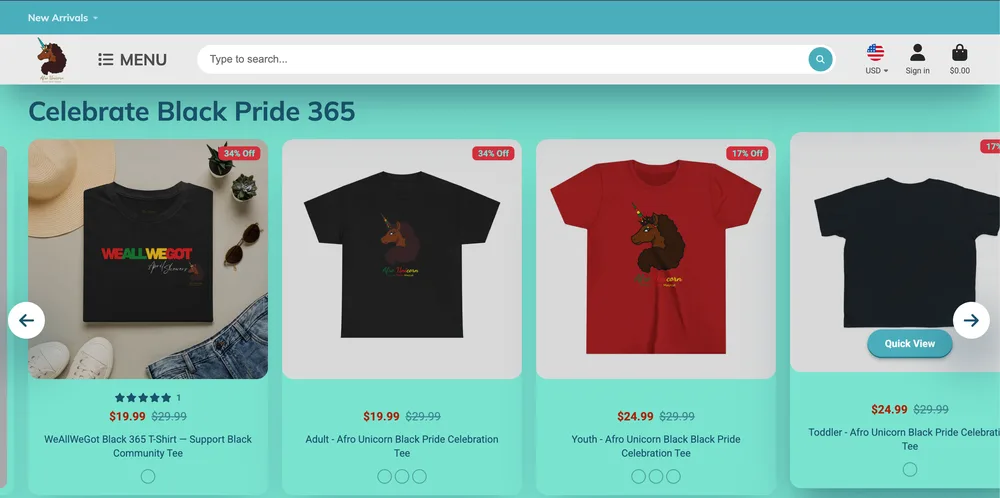
Afro Unicorn hit 10,000 followers and $100,000 in organic revenue in its first year, with customers sharing the brand because they felt represented by it. No ad spend drove that, the brand itself did the selling, and the store existed to close what the community had already decided to buy.
What's easy to miss is that Afro Unicorn was never really selling t-shirts. It was selling the idea that Black women and girls deserve to see themselves as unicorns, magical, unique, divine, in a category that had never bothered to include them. The apparel is the souvenir of that idea, not the product itself. That's why the founder could grow it into a real, standalone brand with its own retail presence, something that never happens to a store that's just a catalog with a logo on it.
FIERCEPULSE: seven figures from a tight niche
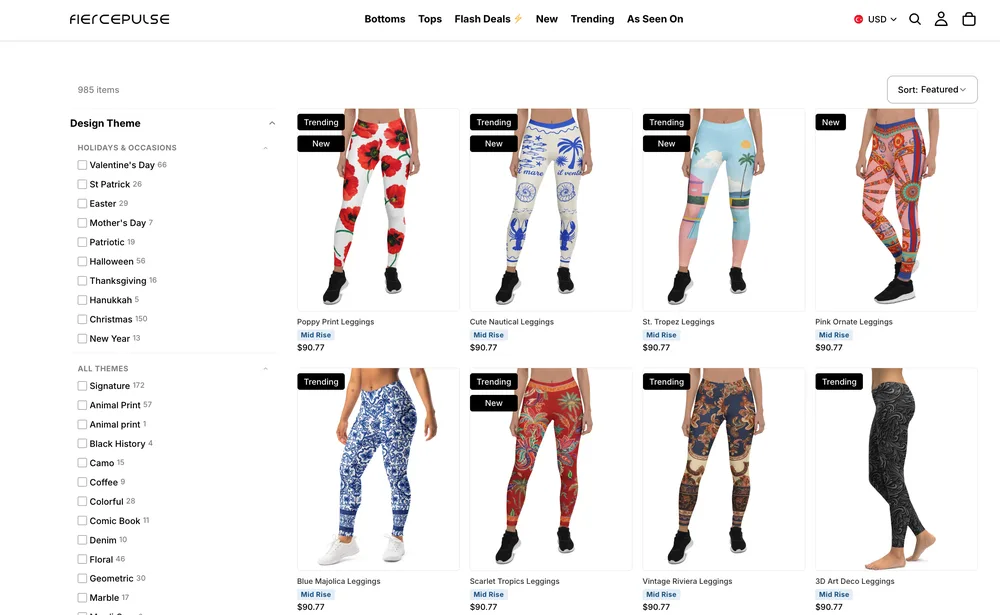
Seven-figure annual revenue from a leggings store with around 14,000 Instagram followers, a small audience by influencer standards. The lesson isn't reach. They sell one thing, leggings, and they sell it deeper than anyone else: over 900 prints in a category where most competitors carry a few dozen.
That is a different move from the usual POD sprawl. The catalogue is huge, but it is huge inside one category, and every print says the same thing: bold and loud, for women who have spent years being told to tone it down. Nothing in the range is there because it was trending that week, which is how a first-time buyer turns into someone who comes back for the next drop.
Sloth Hiking Club: one joke, 25,000 customers
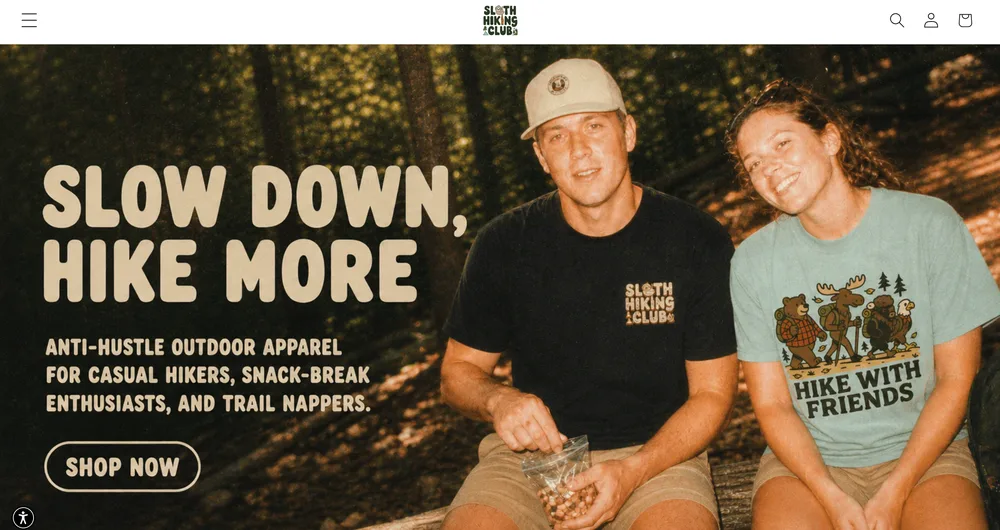
A brand built on a single, specific joke: slow hikers, unbothered, in no hurry to reach the summit. Not an outdoor-apparel catalogue with a sloth on one of the shirts.
A generic "hiking apparel" store competes with every outdoor brand on price and selection. A store built around one unbothered, slow-and-proud character competes with nobody, because it is the only place to buy into that particular joke. Their own site puts it at more than 25,000 customers. The sloth isn't decoration on the products, it's the reason the products exist.
The pattern across all three
None of these are the biggest names in POD, and that is the point. You do not need huge volume to make real money. What all three share isn't a niche or a price point, it's that somewhere along the way they stopped being a print on demand store and became an actual brand with a story a customer wants to be part of: representation, self-expression, an inside joke, whatever it is. The product page didn't have to work as hard to convince anyone, because the story already had.
The story sells. The page closes.
Build the Page Before You Buy the Ad
Why ad spend can't fix a weak product page
Ads are a multiplier.
They multiply whatever conversion rate the page already has, good or bad. Spend $2,000 driving traffic to a 1% converting page and you've bought a very expensive way to confirm the page doesn't work. Fix the page first and the same ad budget goes further on the first try.
What BrandyBee does differently
Instead of a template filled in once, BrandyBee builds product pages from proven layouts, writes copy that is actually SEO-optimized so the page can earn organic traffic you do not have to pay for, and generates product visuals without a photoshoot. It's the same move the survivors above made, done without needing a design team or a content agency to do it.
So, Should You Start a POD Store in 2026?
Yes, if you treat it like a brand, not a shortcut
The market is real and still growing 23% a year. The failure rate is real too, and it isn't caused by the things most guides warn you about. It's caused by stores that never gave a shopper a reason to choose them specifically, and then paid to send more strangers to find that out.
The one-line takeaway
Pick your provider deliberately, build a page worth sending traffic to, and only then buy the ad. In that order, not the reverse.
Frequently asked questions
Is print on demand still profitable in 2026?
Yes, the market is growing 23-25% a year, but profitability now depends far more on brand positioning and page quality than on picking the "right" provider or product.
Why do most print on demand stores fail?
Not fulfilment or providers, mostly. Stores fail when they launch a generic catalog with stock mockups and templated copy, then spend on ads to compensate for a page that was never going to convert.
Which POD provider should I use, Printful, Printify, or Gelato?
Printful for premium apparel and brand control, Printify for the lowest base cost at volume, Gelato for international orders where local production cuts shipping time and cost.
How much does it cost to start a POD store on Shopify?
Provider fees are pay-per-order with no inventory cost, so the real upfront spend is your Shopify subscription plus whatever you invest in the product page itself, design, copy, and images.
Do I need paid ads to grow a POD store?
No. Several stores in this post, Afro Unicorn among them, grew to six figures with zero paid ad spend by building a brand a community wanted to share.
What makes a POD product page convert?
Specific brand voice instead of generic template copy, visuals that look like they belong to that brand rather than a stock catalog, and clear positioning that gives a shopper a reason to buy here instead of the identical product elsewhere.