AI Shopping Statistics: How Shoppers Use ChatGPT, Gemini and AI Mode to Buy
The numbers behind AI shopping: how many people use AI to shop, how AI traffic converts, whether shoppers let agents buy, and what the market could be worth.

AI shopping went from a curiosity to a channel in about two years. ChatGPT now has more than a billion weekly users, Google has put checkout inside Search and Gemini, and traffic from AI assistants to online stores has gone from converting worse than other traffic to converting better. At the same time, most shoppers still do not want an AI to buy for them.
This page collects the numbers that matter for a store, each one taken from the source that published it: the survey, the earnings release or the analytics report itself. Surveys ask different questions, so I kept each number in the words its source used. "Used", "plans to use" and "used or plans to use" are not the same thing, and many of these numbers come from companies that sell AI, analytics or payments, which I note where it matters. Dates are when each source was published. I update this page as new data comes out.
AI shopping statistics in eight numbers
How many people use AI to shop?
Between a quarter and a half of consumers have used AI somewhere in their shopping, depending on the country and on how the question is asked. Some surveys show that share flat (Capgemini, Adobe), others show it rising fast (Salesforce, Deloitte). Among people who already shop with AI, use is growing faster.
- 25% of consumers in 12 countries used generative AI shopping tools in 2025, up from 24% in 2024 and 20% in 2023, and another 31% plan to. (Capgemini, 12,000 consumers, January 2026)
- 45% of consumers turn to AI for help during their buying journey, across 18,000 people in 23 countries. (IBM and NRF, January 2026)
- 39% of US consumers say they have used AI for online shopping, and 85% of them say it improved the experience. The share has stayed around 38% to 39% since early 2025. (Adobe, 5,000+ US consumers, April 2026)
- About half of consumers have made a purchase decision with the help of generative AI. (Accenture, 18,000 consumers in 14 countries, June 2025)
- 50% of shoppers use an AI assistant at some point in the buying journey, up 67% year over year, and 21% used a third-party AI chat assistant in the past 12 months. (Salesforce, July 2026)
- Shopping-related use of generative AI grew 35% between February and November 2025, and 66% of users use it at least weekly. (BCG, January 2026)
- Only 2.1% of consumer ChatGPT messages were about products to buy between May 2024 and June 2025, before ChatGPT's shopping features launched, in OpenAI's own analysis of about 1.1 million conversations. (OpenAI, September 2025)
That last number is worth holding next to the others. Shopping was a small share of what people did in ChatGPT, but on a base that has since passed a billion weekly users, even a small share is a lot of shopping conversations.
How many people use each AI assistant
- ChatGPT has more than 1.2 billion weekly users, up from more than 900 million in February 2026. (OpenAI, October 2026)
- Google's AI Overviews reach more than 2.5 billion users a month and AI Mode more than 1 billion. (Alphabet, June 2026)
- The Gemini app passed 1 billion monthly users in August 2026. (Google)
- Amazon's shopping assistant Rufus was used by more than 300 million customers in 2025, and Amazon says it helped deliver nearly $12 billion in incremental annualized sales. (Amazon, February 2026)
- Perplexity answers more than 150 million questions a week. (PayPal and Perplexity, November 2025)
What shoppers use AI for
Research, mostly. Shoppers use AI to compare products, read reviews faster and find deals. Far fewer use it to buy.
- Consumers use AI to research products (41%), make sense of reviews (33%) and find deals (31%). (IBM and NRF, January 2026)
- US shoppers who use generative AI use it for research (53%), product recommendations (40%), deals (36%), shopping lists (30%) and gift ideas (30%). (Adobe, August 2025)
- 25% of consumers worldwide now name AI platforms such as ChatGPT as their top research tool. (Adobe, 4,000 consumers, February 2026)
- 54% of shoppers who used AI double-checked all the information it gave them, and 62% said it ended up wasting their time. (Gartner, 846 consumers who used AI for a recent purchase, May 2026)
- 64% of shoppers who use AI for gift ideas still open a separate tab to buy, instead of using the link the AI gives them. (PwC, 4,093 US consumers, June 2026)
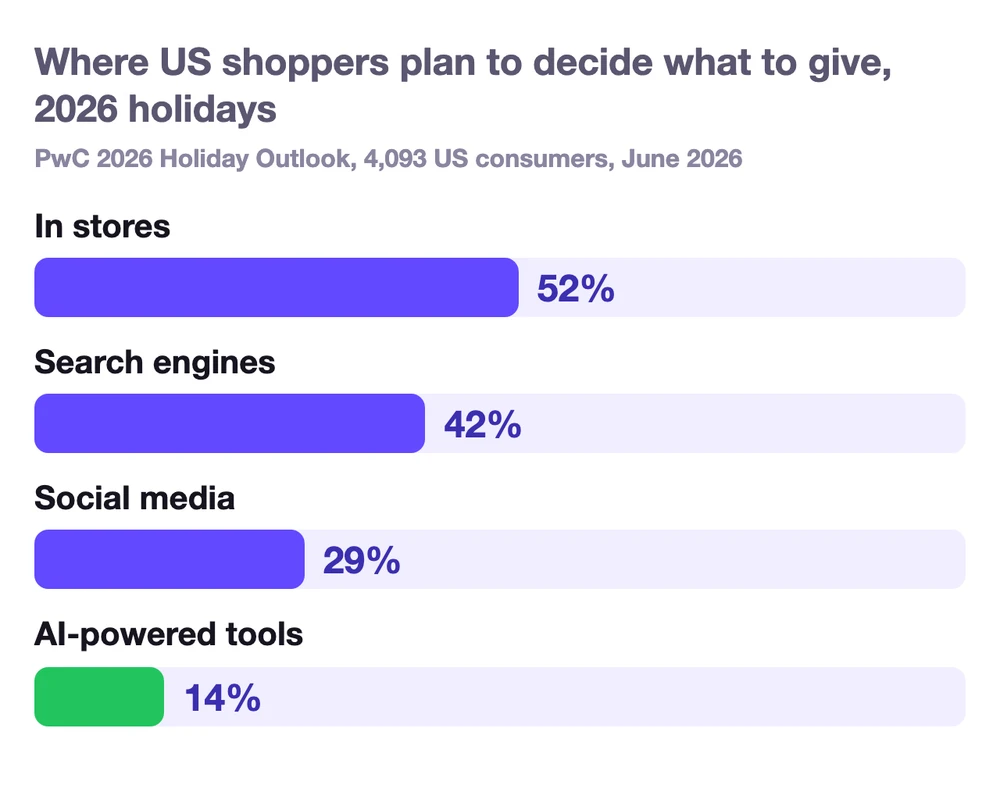
For holiday gifts, AI still sits well behind stores, search engines and social media as a place people decide what to buy. Only 14% of US shoppers plan to use AI tools for it, and only 4% expect to make the purchase through an AI tool.
AI traffic to online stores
Traffic from AI assistants to online stores is growing far faster than traffic overall, from a small base. Every source below measures it differently, so the growth rates are not comparable with each other.
- Traffic from generative AI tools to US retail sites rose 693% over the 2025 holiday season compared with 2024, and 670% on Cyber Monday. (Adobe, January 2026)
- AI traffic to US retail sites grew 393% year over year in the first quarter of 2026. (Adobe, April 2026)
- In July 2026, AI traffic to US retail sites was up 62% year over year and up 1,219% since October 2024. (Adobe, August 2026)
- AI platforms sent an average of 770.7 million referral visits a month to websites of every kind worldwide between June 2025 and May 2026, up 117% year over year. Marketplaces got the most, at 46.8 million a month, up 237%. (Similarweb, September 2026)
- Traffic referred from AI chats grew between 150% and 428% year over year in every quarter from early 2024 to early 2026, while overall traffic grew in single to low double digits. (Salesforce, July 2026)
- AI-driven traffic to Shopify stores grew 197% year over year in the second quarter of 2026, and 75% of AI-attributed orders came from outside the 100 biggest product categories. (Shopify, September 2026)
- Across 973 ecommerce sites, traffic from AI chat tools made up less than 0.2% of all sessions between August 2024 and July 2025. (Marketing Science, peer-reviewed, 2026)
The last number is the one to keep the others in proportion. Growth of several hundred percent on a very small base is still a small channel for most stores. Shopify stores still get more sessions from organic search than from all tracked AI platforms combined.
Does AI traffic convert better?
It does now. A year and a half ago, it did not. Adobe has tracked the same comparison since early 2025, across single months, Prime Day events and the November to December season, and the turn is clear:
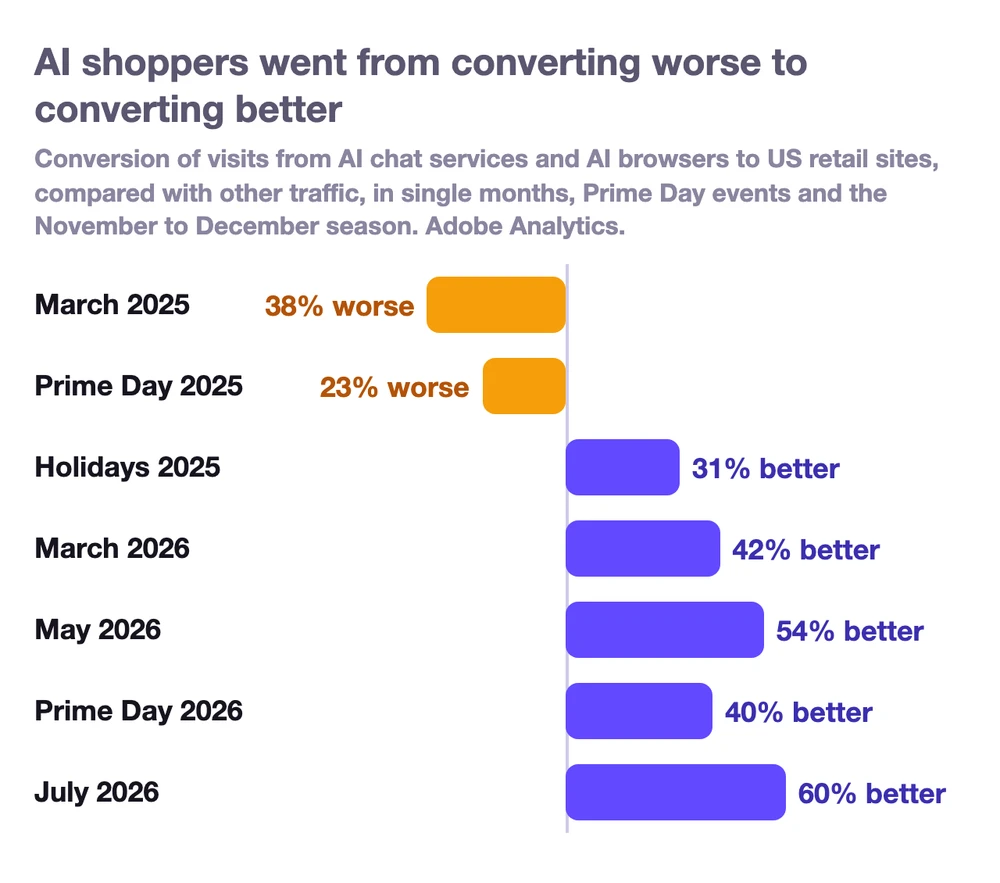
- AI traffic converted 38% worse than other traffic in March 2025 and 42% better in March 2026. (Adobe, April 2026)
- In July 2026, AI traffic converted 60% better than other traffic, the 11th month in a row ahead. (Adobe, August 2026)
- On Prime Day 2026, AI visitors converted 40% better than other channels, after converting 23% worse on Prime Day 2025. (Adobe, June 2026)
- In May 2026, AI visits converted 54% better and brought 53% more revenue per visit than other traffic. A year earlier, other visits were worth 128% more than AI visits. (Adobe, June 2026)
- Over the 2025 holidays, AI referrals converted 31% better than other traffic, and shoppers who came from AI were 33% less likely to leave right away and spent 45% more time on the site. (Adobe, January 2026)
- In the first quarter of 2026, AI-referred Shopify sessions that started on a product page converted nearly 50% better than organic search sessions that did, and AI-attributed orders were 14% larger. (Shopify, May 2026)
- Over the 2025 holidays, shoppers who came from AI search converted nine times more often than shoppers who came from social media, usually the weakest-converting referral source. (Salesforce, January 2026)
- Amazon says shoppers who use Rufus, who choose to use it, are 60% more likely to complete a purchase. (Amazon, October 2025)
Two caveats. Most of these numbers come from companies that sell analytics or AI, and a peer-reviewed study of 2024 and 2025 data found ChatGPT traffic converting below every channel except paid social, though improving over time. Adobe does not say why the turn happened. One clue: on Shopify, more than half of AI-referred sessions start on a product page, against about 20% from organic search, which fits shoppers who arrive already knowing what they want. That makes the product page, and the product data behind it, the thing an AI shopper actually meets.
Will shoppers let AI buy for them?
Not yet, for most of them. The platforms have built checkout into their assistants. Shoppers mostly want help deciding, then to buy themselves.
- At most 11% of US consumers are willing to let AI make purchase decisions for them, even in low-stakes categories like personal care and household supplies, though 31% would let it narrow down the choices for household supplies. (Gartner, 322 US consumers, May 2026)
- Only 23% of US consumers trust generative AI to handle payments on their behalf. (Visa and The Harris Poll, September 2026)
- About half of consumers are not comfortable letting AI handle a purchase from start to finish, and shoppers trust a retailer's own agent three times more than a third-party one. (Bain, November 2025)
- 55% of US and UK shoppers are not comfortable with AI agents making purchases on their behalf. (Riskified, 2,000 shoppers, April 2026)
- 76% of consumers want clear rules for when an AI assistant can act, and 71% worry about how generative AI tools use their data. (Capgemini, January 2026)
- 50% of US shoppers click links an AI assistant gives them, and 27% complete purchases through those links. (Adobe, June 2026)
AI checkout, launch by launch
- September 2025: OpenAI launched Instant Checkout in ChatGPT with the Agentic Commerce Protocol, starting with US Etsy sellers. (OpenAI)
- November 2025: PayPal and Perplexity launched Instant Buy for US users, and ChatGPT added shopping research. (PayPal, OpenAI)
- December 2025: Shopify launched Agentic Storefronts, connecting merchants' products to ChatGPT, Perplexity and Microsoft Copilot from one setup. (Shopify)
- January 2026: Google launched the Universal Commerce Protocol with Shopify, Etsy, Wayfair, Target and Walmart, and Microsoft began rolling out Copilot Checkout in the US. (Google, Microsoft)
- March 2026: OpenAI stepped back from Instant Checkout and let merchants use their own checkout, keeping the protocol for product discovery. (OpenAI)
- October 2026: Google started rolling out Universal Cart in the US across Search and the Gemini app, built on more than 60 billion product listings. (Google)
OpenAI's step back is the most telling line in that list. The protocols are spreading, but the part shoppers adopt first is discovery, not handing over the checkout. I went through what Universal Cart means for a store's product data in why Merchant Center disapproves products.
AI and holiday shopping
- 33% of US consumers planned to use generative AI for their 2025 holiday shopping, more than double the 15% in 2024: 43% of Gen Z and 22% of Baby Boomers. (Deloitte, 3,981 US consumers)
- 48% of consumers in 10 countries had used or planned to use generative AI for year-end shopping in 2025, 9 points more than in 2024. (BCG, November 2025)
- 17% of US online shoppers said they would start their 2025 holiday shopping on an AI platform such as ChatGPT or Perplexity, against 30% on Google Search. (Bain, November 2025)
- Salesforce estimates that AI and agents influenced $262 billion, or 20%, of global online holiday sales in 2025. That counts product recommendations and service on retailers' own sites, not only AI chats. (Salesforce, January 2026)
- 29% of US consumers plan to use AI somewhere in their 2026 holiday shopping, up from 22% the year before. (PwC, June 2026)
- Adobe forecasts AI traffic to US retail sites to rise 130% over the 2026 holiday season. (Adobe, September 2026)
How big will AI shopping get?
The forecasts disagree by a factor of five, mostly because they define agentic commerce differently. Read them as a range, not a number.
- Agentic shoppers could account for $190 billion to $385 billion of US ecommerce spending by 2030, 10% to 20% of the total. (Morgan Stanley, December 2025)
- US agentic commerce could reach $300 billion to $500 billion by 2030, about 15% to 25% of ecommerce. (Bain, December 2025)
- Agentic commerce could orchestrate up to $1 trillion in US retail revenue by 2030, and $3 trillion to $5 trillion worldwide. (McKinsey, October 2025)
What BrandyBee's own research found
Two of my own studies add the store side of these numbers.
- When I asked ChatGPT and Google AI Mode the same 100 shopping questions, they recommended the same top product only 38% of the time. Of the 138 products they recommended, 17 had no machine-readable product data on the page, and all 17 were listed in Google Shopping, which suggests the feed, not the page markup, got them shortlisted. Details are in the AI shelf report.
- In 1,000 Shopify stores popular with US shoppers, 15% of the 10,000 titles I checked did not say what the product was, and 7% of all 196,484 products had no description at all. That is much of the text an AI assistant has to work from when it decides what a product is.
What the numbers mean for a store
AI is not yet a large share of most stores' traffic, but it is the share that is growing and, in Adobe's US data since autumn 2025, converting better than other traffic on average. Shoppers use it to decide, not to hand over the purchase. Google's AI Mode and Universal Cart run on the same Shopping Graph as Google Shopping, and the other assistants read the same kinds of data from product feeds and product pages: titles, descriptions, images, prices, stock and identifiers.
Getting that data right helps in Shopping ads, in free listings and in AI answers at once, which is why I would start there rather than with agentic checkout. The fixes, one by one, are in how to optimize Google Shopping ads.
AI shopping statistics FAQ
How many people use AI to shop?
Between a quarter and a half of consumers, depending on the survey. Capgemini found 25% of consumers in 12 countries used AI shopping tools in 2025, IBM and NRF found 45% turn to AI during their buying journey, and Adobe found 39% of US consumers have used AI for online shopping.
Does traffic from ChatGPT and other AI tools convert?
In Adobe's US retail data, AI traffic has converted better than other traffic on average since autumn 2025, 60% better in July 2026, after converting 38% worse in March 2025. Shopify reports AI sessions that start on a product page converting nearly 50% better than organic search sessions that do. A peer-reviewed study of August 2024 to July 2025 data found ChatGPT traffic converting below most channels, though improving, so the gap is recent.
Do shoppers trust AI to buy for them?
Mostly not yet. At most 11% of US consumers would let AI make a purchase decision for them, even for low-stakes buys (Gartner), 23% trust generative AI with payments (Visa), and about half are not comfortable letting AI complete a purchase end to end (Bain).
How big is agentic commerce?
Forecasts for US agentic commerce in 2030 range from $190 billion (Morgan Stanley) to up to $1 trillion (McKinsey), with Bain at $300 billion to $500 billion. The range is wide because each firm defines agentic commerce differently.
What do shoppers use AI for?
Mostly research: comparing products, summarizing reviews, finding deals and getting gift ideas. Far fewer buy through it. In PwC's 2026 holiday survey, 14% of US shoppers plan to use AI tools to decide what to give, and 4% expect to buy through them.