Shopify Store Statistics: Product Data From 1,000 Stores Popular With US Shoppers
Original data on 196,484 products from 1,000 Shopify stores popular with US shoppers: titles, images, descriptions, prices, discounts and stock.

Most advice about product pages is written from a handful of good examples. I wanted the opposite: what popular Shopify stores actually publish, at a scale where the numbers hold.
To get stores real shoppers visit, not test shops or abandoned ones, I started from Google's own data. The Chrome UX Report lists the million websites US Chrome users visit most, and I used the September 2026 list. 93,004 of those sites run on Shopify. From the ones in the top 100,000, I picked stores at random and read their public product data, until I had 1,000 stores that sell at least 20 physical products of a kind Google Shopping takes. That came to 196,484 products. For most stores, these are their 250 newest products, so the numbers describe what stores are publishing now.
Two things a script cannot judge: whether a title says what the product is, and whether a main image carries a price, a badge or a watermark. For those, I had an AI model check 10 random titles and 10 random main images from every store one by one, 10,000 of each, following one written rule. Then I checked 500 of each by hand to see how often it agreed with me: on 96% of the titles and 99% of the images. Where it disagreed with me on titles, it was usually the more lenient one, so the title number below is if anything on the low side.
The report in eight numbers
How many websites use Shopify?
Of the top 1 million websites US Chrome users visit, 93,004 run on Shopify, 9.4%. I counted a site with and without "www" once, and left out Shopify's own sites and store login pages. The count covers sites whose address points straight at Shopify's servers. Stores behind another network do not show up that way, so treat it as an estimate.
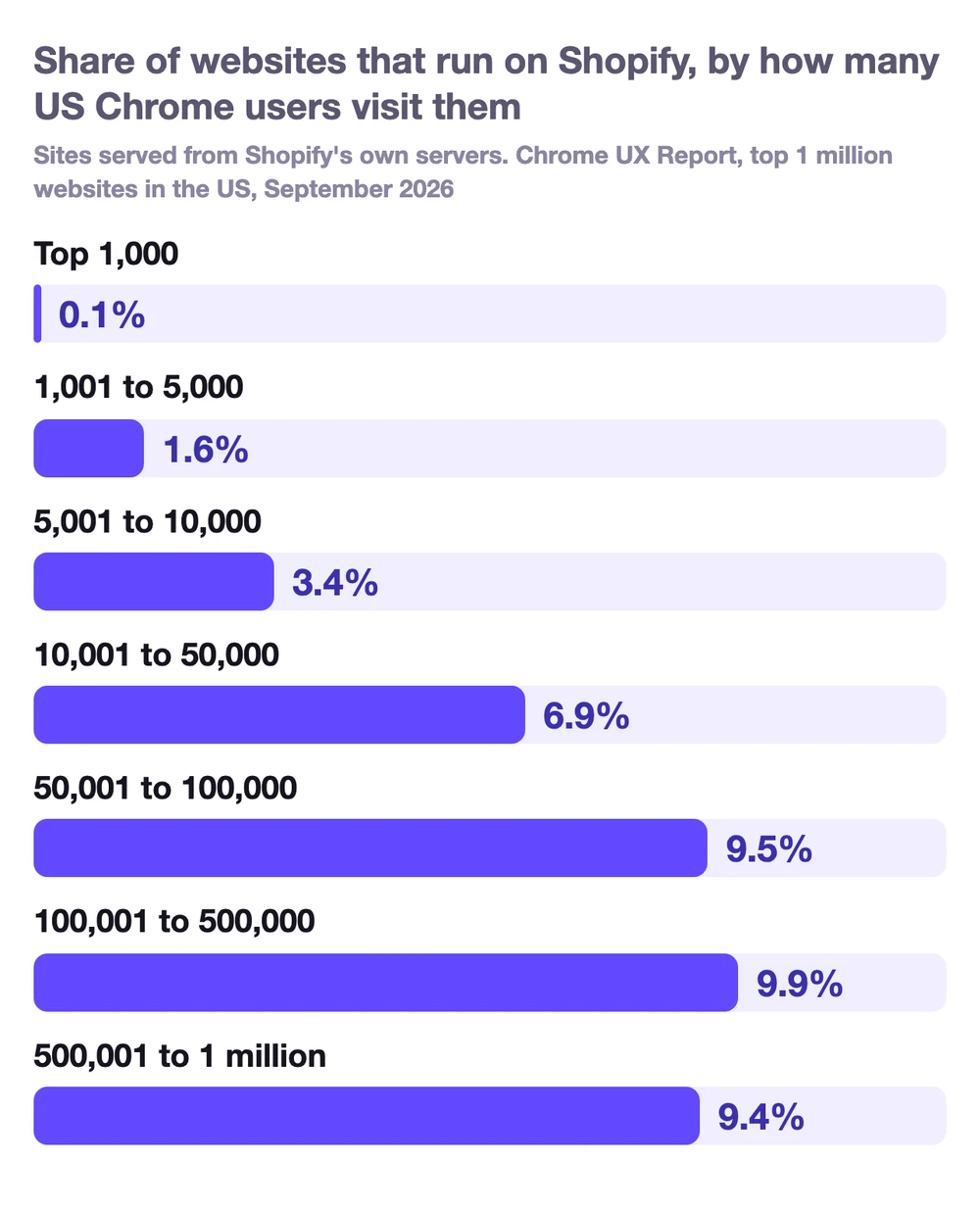
Served from Shopify's own servers, Shopify is almost absent from the very top: outside Shopify's own sites, only one of the 1,000 most visited is. Some of the biggest brands run a custom storefront on top of Shopify, which this count cannot see, so the top of the list is where it undercounts most. Below the top 50,000, about one site in ten is a Shopify store. That is where most Shopify stores sit: 90,033 of the 93,004.
What these stores sell
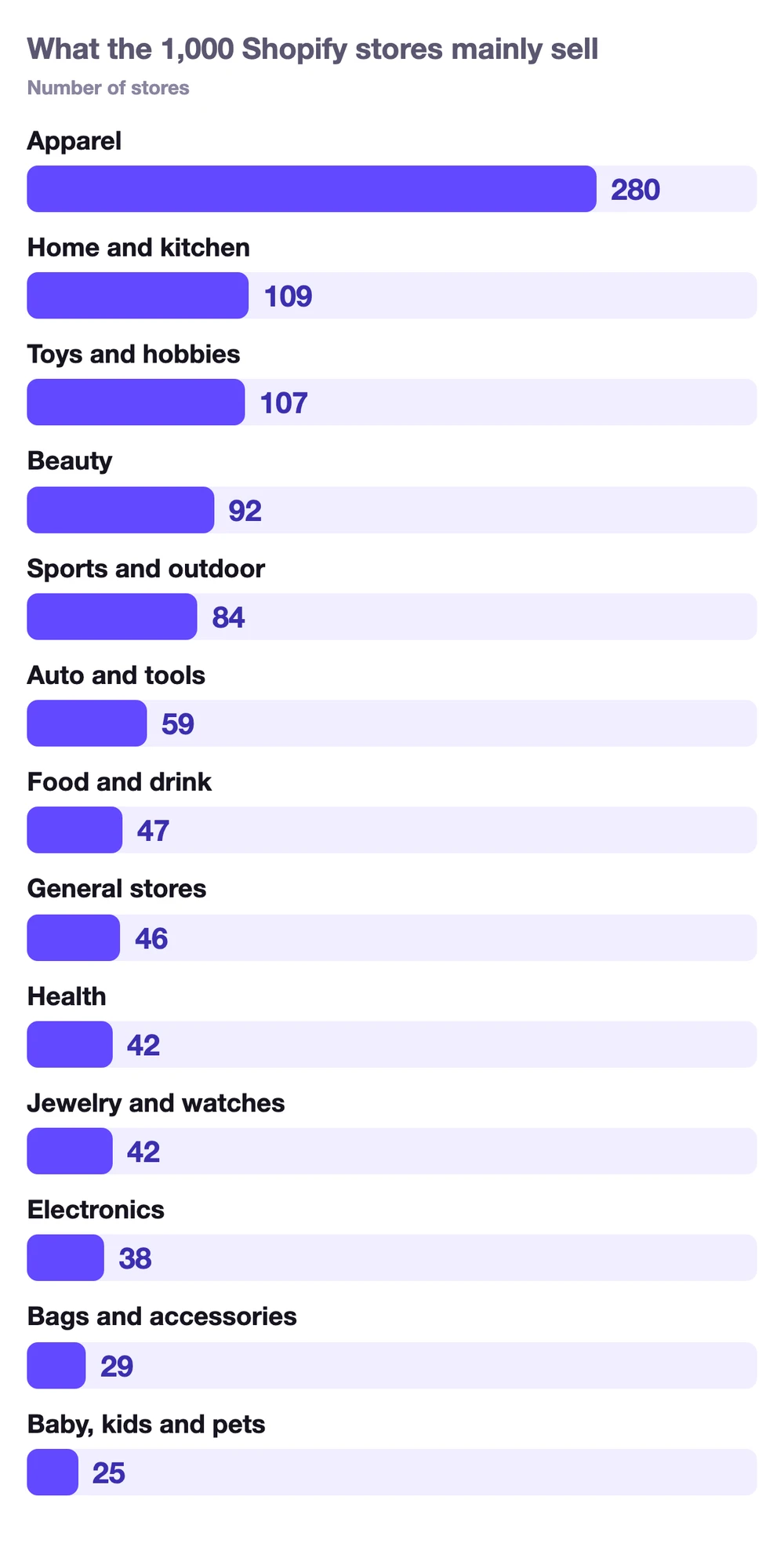
I grouped each store by what it mainly sells. Apparel is the biggest group by far, more than a quarter of the stores. Home and kitchen, toys and hobbies, beauty, and sports and outdoor follow. Baby, kids and pet stores are too few to compare on their own, so the category comparisons below leave them out.
Prices run from everyday buys to considered ones. Among stores that sell in US dollars, the typical product starts at $50, and the middle half of products sit between $24 and $138. Food and drink ($20), toys and hobbies ($21) and beauty ($25) are the cheapest categories. Jewelry and watches ($138) and auto parts and tools ($112) are the most expensive. Most stores list a lot: 62% have 250 or more products.
Product titles: short, and 1 in 7 do not say what the product is
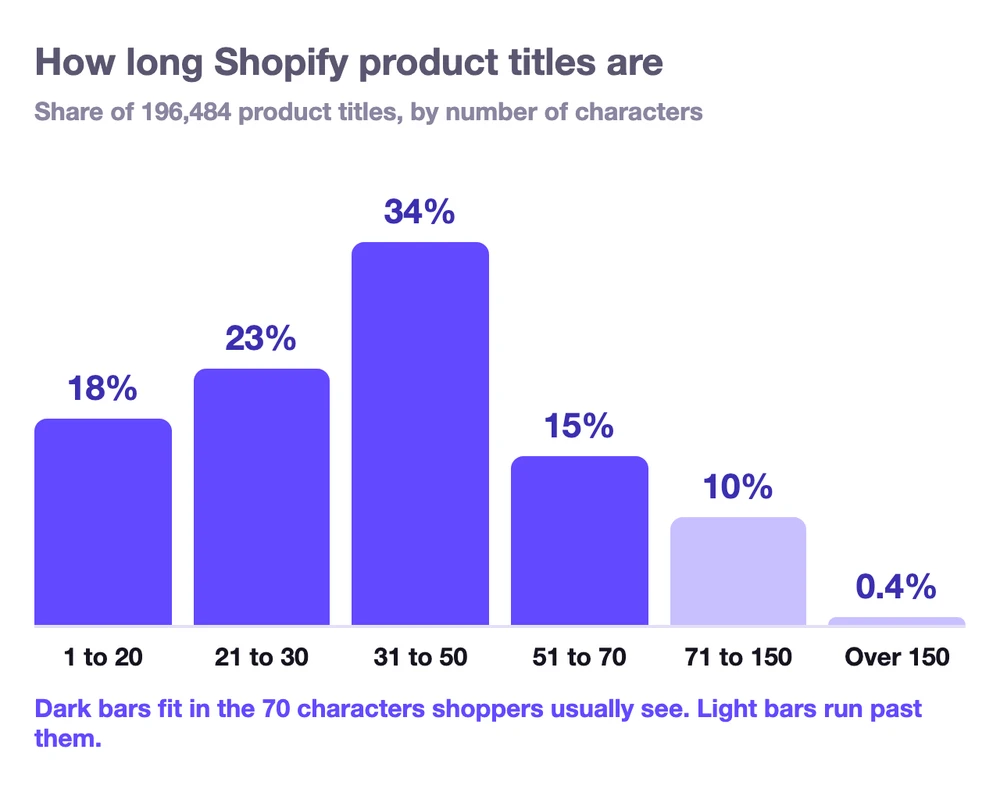
The title is the most important line of product data. It is what Google matches to a search, what a Shopping ad shows next to the image, and what an AI assistant reads first. Google allows 150 characters and says shoppers usually see the first 70.
The typical title is 35 characters. Four in ten are 30 characters or less, and almost one in five is 20 or less. Only one in ten uses more than the 70 characters a shopper sees.
Short is not the problem on its own. The problem is a title that does not say what the product is. For every title I checked, the question was: would a shopper who sees only this title know what kind of product it is? For 15% of the 10,000 titles, about 1 in 7, the answer was no. They were a model number, a shade or scent name with nothing else, or a made-up name that could be anything from a lipstick to a poster. On the store's own page, the photo fills that gap. In a text search result or an AI answer, the title is often all there is, and the products ChatGPT and Google AI Mode recommend are picked largely from that kind of feed data.
It is not a few stores doing it. 39% of the stores had at least one such title among the 10 I checked, and in 13% of stores it was half or more. It was most common in health (32%), bags and accessories (26%), beauty (25%), toys and hobbies (22%) and electronics (21%), where products are often given names rather than descriptions. It was least common in general stores (7%), auto parts and tools (9%) and apparel (10%).
Two smaller problems:
- 3.9% of titles are written in all capitals. In 33 stores, it is half or more of the products I read. Google tells merchants not to use capital letters for emphasis, and Merchant Center can flag such titles with an "Excessive capitalization" issue.
- In my check, fewer than 1 in 100 titles carry promotional text like "final sale" or "best seller", which Google does not allow in titles. Stores mostly get this one right.
Product images
The typical product has 5 images. But 18% of products have only one, and 2% have none. A single image is common in toys and hobbies, where 37% of products have just one, and rare in bags and accessories (8%) and apparel (9%), where shoppers expect to see the product worn on a model and from several angles.
The first image matters more than the rest, because it is usually the one Google Shopping shows, and the one ads and shopping assistants show first. 11% of the 10,000 main images I checked, about 1 in 9, show something Google's main-image rules do not allow. 10% have something added on top: a price or a coupon code, a "New!" or "Free gift" badge, a "Sold out" banner, feature call-outs, a quantity label, a watermark, a logo stamped in a corner. Another 1.5% are not product photos at all, such as a brand logo standing in for the product or a cartoon. Google does not allow promotional text, prices, watermarks, added logos or placeholders on the main image, and asks for a clean, unobstructed view of the product, and 34% of stores had at least one such image among the 10 I checked. Auto parts and tools (23%), toys and hobbies and general stores (18%) had the most, though Google is more lenient with generic images for vehicle parts and hardware. Jewelry, bags and accessories (5%) and apparel (6%) had the fewest.
About 6 in 10 main images sit on a solid white or transparent background, 48% white and 12% transparent. On my own reading of 500 of them it came out a little lower, at about half. Electronics (91%) and sports and outdoor (81%) use one most. For clothing, Google's best-practice guide recommends a solid white or transparent background, but in apparel fewer than half of main images (47%) have one. Most of the rest are models in a studio with a coloured or grey backdrop, or out on location. Google does suggest showing clothing on a model, just against a white or transparent background in the main image.
One more number to watch: 2.7% of main images are smaller than 500 pixels on their short side, and 31% of stores have at least one. From January 31, 2027, Google requires every product's main image to be at least 500 by 500 pixels.
How many images each category needs, and which kinds, is in my breakdown of how many images a product page needs.
Product descriptions
The typical description is 490 characters, about 80 words. That is short for something that has to answer a shopper's questions. 11% of descriptions are under 150 characters, and 7% of products have no description at all. 45% of stores have at least one product with an empty description, and empty descriptions were most common in health (15%), electronics (14%) and beauty (12%).
An empty description costs twice. Merchant Center warns about it, and it is one of the places AI shopping assistants look to understand what a product is for. If yours are thin, a description written from the product's real details fixes both.
Shipping weight
38% of shippable variants have no shipping weight. 83% of stores have at least one, and in a third of stores it is half or more. The typical store is missing it on 12% of variants, so a minority of stores with no weights anywhere pull the total up. This is also the number most tilted by reading newest products: in the stores where I could read the whole catalog, newer products missed a weight more often than older ones.
A missing weight only causes trouble if your shipping rates use it, for example carrier-calculated rates. I went through when it matters, and every other Merchant Center issue, in why Google Merchant Center disapproves products.
Discounts and stock
25% of the newest products in these stores are on sale, meaning their price is below a crossed-out compare-at price. The typical discount is 30%. Discounts are everywhere: 79% of stores discount at least one of the products I read, and in 1 in 5 stores, half or more of the newest products are discounted. Home and kitchen (32%) and beauty (31%) discount most often. Food and drink (15%) and electronics (16%) the least.
11% of the newest listed products are sold out, every variant unavailable. Toys and hobbies (19%), electronics (17%) and jewelry (16%) carry the most. A sold-out product that still sits in your feed has to say so, both in the feed and on the page. When the two disagree, Merchant Center can disapprove the product, and the product schema on the page has to agree with both, which you can see for any page in the free product data checker.
Every category in one table

A few patterns stand out. Toys and hobbies, which here also covers crafts, collectibles, games, music and films, has the most single-image products and the most sold-out items. Auto parts and tools writes the longest titles and the longest descriptions, and adds the most text to its main images. Health, bags and accessories, and beauty have the most titles that do not say what the product is. Apparel has the most variants by far, a median of 6 per product, against 1 in most other categories.
What this means for your store
None of these gaps are hard to fix. They are just easy to miss, because a store's own product page hides most of them: the photo explains the title, and the theme fills in what the data leaves out. Feeds, ads and AI shopping assistants get the raw data. Five checks cover most of it:
- Read your titles without the photo. If a title does not say what the product is, add the product type, and the colour or size where it matters. You have about 70 characters before a shopper stops reading.
- Look at your first image the way Google does. No prices, codes, badges, banners or watermarks, and no logos standing in for a product. For clothing, Google recommends a white or transparent background in the main image.
- Give every product a real description. Empty and one-line descriptions leave shoppers and assistants with nothing to go on.
- Fill in weights if your shipping rates use them.
- Keep sold-out products honest. The stock in your product feed has to match the page.
Shopify store statistics
The main numbers from this report in one place. Unless a line says otherwise, they cover 196,484 products from 1,000 Shopify stores picked at random among the 100,000 websites US Chrome users visit most, mostly each store's newest products:
- 93,004 of the top 1 million websites US Chrome users visit run on Shopify, 9.4%. Among the top 100,000 it is 7.7%, and among the top 1,000 just one site outside Shopify's own.
- The typical Shopify product title is 35 characters long, against the 150 characters Google allows.
- 41% of Shopify product titles are 30 characters or less, and only 10% use more than the 70 characters Google says shoppers usually see.
- In 10,000 Shopify product titles checked one by one by an AI model, with 500 checked by hand (96% agreement), 15% (about 1 in 7) did not say what kind of product it was. 39% of stores had at least one such title among 10 checked.
- 3.9% of Shopify product titles are written in all capitals.
- The typical Shopify product has 5 images, but 18% have only one and 2% have none.
- In 10,000 Shopify main product images checked one by one by an AI model, with 500 checked by hand (99% agreement), 11% (about 1 in 9) carried a price, a badge, promotional text or a watermark, or were not a product photo. 34% of stores had at least one among 10 checked.
- About 6 in 10 Shopify main product images sit on a solid white or transparent background. In apparel it is fewer than half.
- 2.7% of Shopify main product images are smaller than 500 pixels on their short side, and 31% of stores have at least one.
- The typical Shopify product description is 490 characters, about 80 words. 7% of products have no description at all.
- 38% of shippable Shopify product variants have no shipping weight, and 83% of stores have at least one such variant.
- 25% of Shopify products are on sale, at a typical discount of 30%, and 79% of stores discount at least one product.
- 11% of listed Shopify products are sold out.
- Among Shopify stores selling in US dollars, the typical product starts at $50, and half of all products cost between $24 and $138.
To cite this report: BrandyBee, "Shopify Store Statistics", October 2026, https://brandybee.ai/blog/shopify-store-statistics/.
Shopify store statistics FAQ
How many websites use Shopify?
Among the top 1 million websites US Chrome users visit, 93,004 run on Shopify, 9.4%, counting sites whose address points straight at Shopify's servers. Shopify is rare among the most visited sites and much more common further down the list, where about one site in ten is a Shopify store.
How long are product titles on Shopify?
In the 1,000 stores I read, the typical product title is 35 characters. Four in ten are 30 characters or less, and only one in ten is longer than 70 characters, the part of a title Google says shoppers usually see. Google allows up to 150.
How many images does a Shopify product have?
In these 1,000 stores, the typical product has 5 images. 18% of products have only one image and 2% have none. Bags and accessories and apparel have the fewest single-image products, and toys and hobbies the most.
How long should a product description be?
There is no fixed length, but it should answer what a shopper would ask before buying: what the product is, what it is made of, the size and fit, and how to use or care for it. The typical Shopify description is about 80 words. One in nine products has a description under 150 characters, which is too short to do that, and another 7% have none.
How many Shopify products are on sale?
Among the newest products of these 1,000 stores, a quarter are on sale, priced below a crossed-out compare-at price, at a typical discount of 30%. 79% of stores discount at least one of them, and in one store in five, half or more of the newest products are discounted.