How to Test Meta Ad Creatives: A Step-by-Step Guide for Ecommerce Stores
How to test Meta ad creatives properly: the hypothesis, the right test type, the budget, how long to run it and how to read the winner, built on Meta's own guidance.

Most stores test Meta ad creatives by putting a few ads into one ad set and keeping whichever gets the most spend. That tells you which ad Meta preferred that week. It does not tell you which creative is better, and Meta's own documentation warns against testing informally.
This guide is the method I use instead. Every step is built on Meta's Business Help Center and developer documentation, with two independent studies on where platform tests go wrong, and benchmark data on what a normal result looks like. If you want to know which creative types to test first, start with the best performing Meta ad creatives for ecommerce. This post is about how to test them.
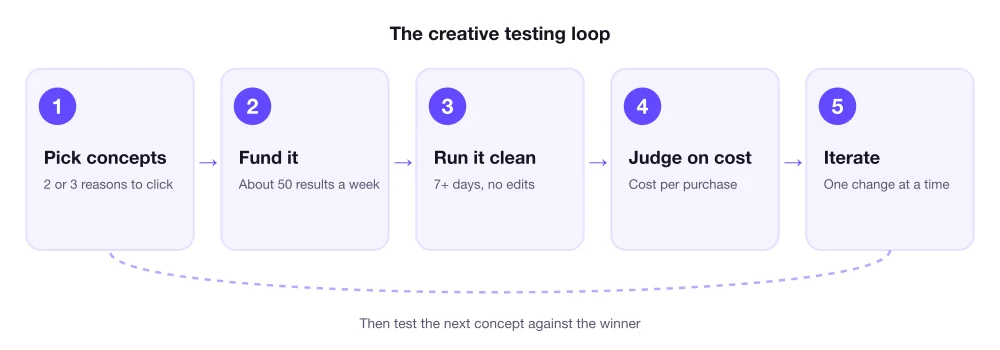
- Test one variable against a written hypothesis. Meta's own best practices say your versions should be identical except for the thing you are testing.
- Use a real test, not an on and off switch. Meta does not recommend informal testing, because overlapping audiences make the result unreliable.
- Budget for about 50 results a week for each version. That is when Meta says an ad set usually exits the learning phase. At a $38.99 cost per purchase, that is around $1,950 a week per version.
- Run at least 7 days and do not edit. Meta recommends a minimum of 7 days and says edits during learning reset it.
- Judge on cost per result, not CTR. Meta picks the winner on cost per result, and the category with the highest CTR has the lowest ROAS.
- Know the test's limit. Research including Meta's own researchers finds platform A/B tests can show each ad to a different kind of person. Treat a winner as "the ad to run next", not a universal truth.
Why creative testing is worth the trouble
Meta is direct about it. Its learning phase documentation says that "testing new creative and marketing strategies is essential for improving your performance over time." The reason is that winners are rare. In one large benchmark from the creative analytics company Motion, about one creative in twenty became a winner, and those few took 55% of all spend. Whatever the exact rate in your account, most new creatives will not beat your current best. A test is how you find the one that does without wasting the rest of the budget.
Step 1: Write a hypothesis and pick one variable
Meta's A/B testing best practices start with two rules: test one variable, and turn your question into a measurable hypothesis. "Will a different image help?" is a question. "An offer-first banner will get a lower cost per purchase than our lifestyle photo" is a hypothesis you can act on.
For creative, the variable is usually one of two things:
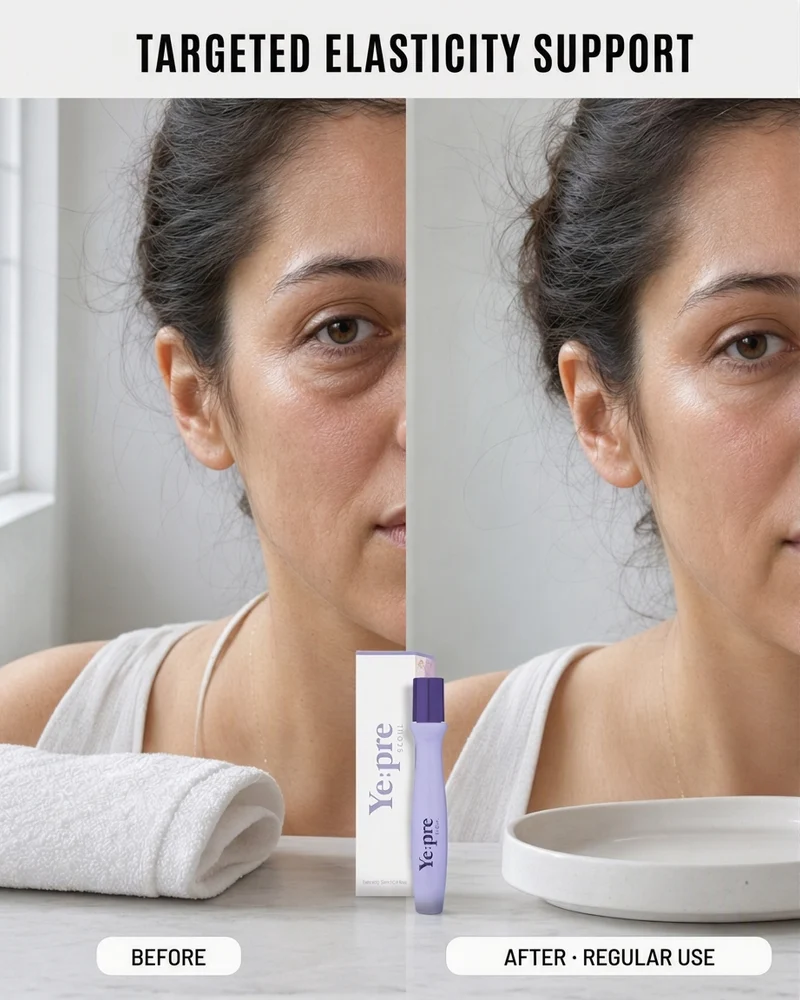
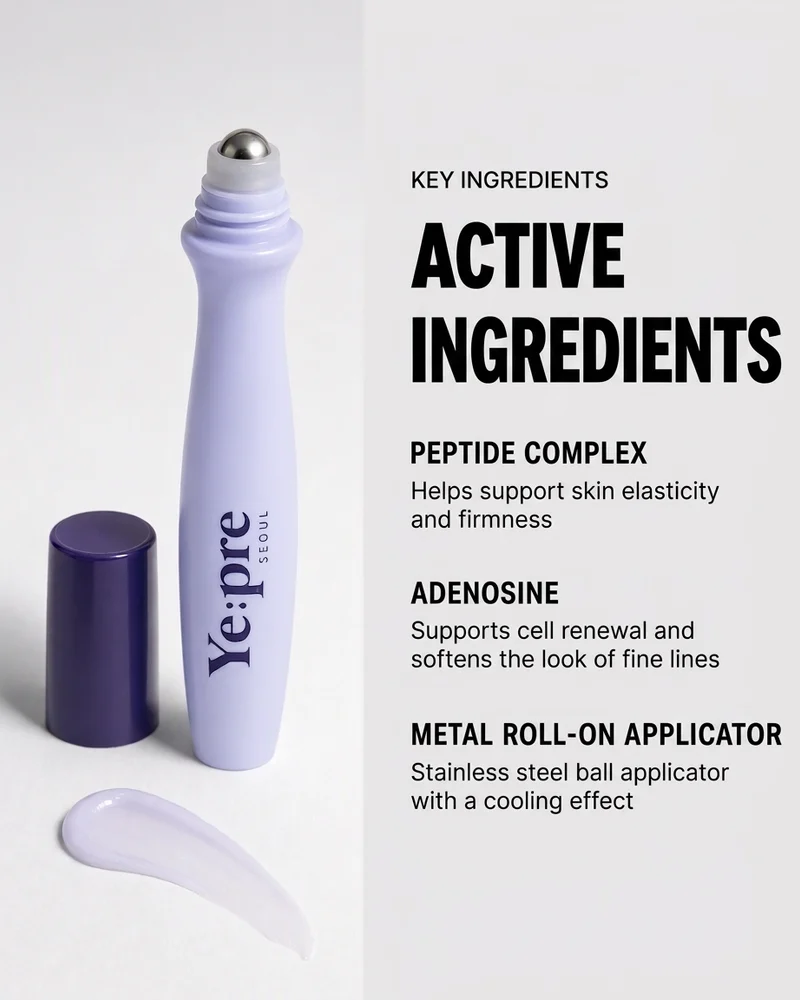
- A concept: a different reason to click. A before-and-after photo against a benefit infographic against an ingredient breakdown. Test these first: they are the bigger change, and a bigger difference is easier to detect on a small budget.
- A variant: one change inside a concept that already works. A new headline, a different scene, another background, a different first line of text.
Here is what a concept test looks like for one product. These four images were made in BrandyBee for the Ye:pre Timeless Peptide Eye Roll On, a Korean eye serum. Each one gives the shopper a different reason to click:


Once a concept wins, a variant test changes one thing inside it. Say the lifestyle image won. The next test keeps the product, the model and the light, and changes only the setting:

Copy works the same way. On a discount banner, keep the image and change only the headline:



Keep everything else the same: the product, the offer, the landing page, the audience and the budget. If you change the image and the headline at once and the ad wins, you will not know why. Making two or three concepts for the same product is the slow part, and it is where an ecommerce ad creative generator saves the most time.
Step 2: Choose how to run the test
There are three ways to compare creatives on Meta, and they are not equal.
| Method | How it works | Use it when |
|---|---|---|
| Meta A/B test | Meta splits the audience so nobody sees both versions, then compares cost per result | You want a reliable answer to one question |
| Creative testing in the ad editor | Meta duplicates your ad into 2 to 7 test ads and spreads spend evenly across them | You want to compare several creatives inside a running campaign |
| Several ads in one ad set | Meta's delivery chooses which ad to spend on | You only want to run, not learn |
Meta A/B test. Meta's A/B testing shows each version to a segment of your audience and makes sure nobody sees both. You can build one in Ads Manager or the Experiments tool, either by duplicating a campaign, ad set or ad and changing one variable, or by comparing two that already exist. Meta recommends the same budget for both versions.
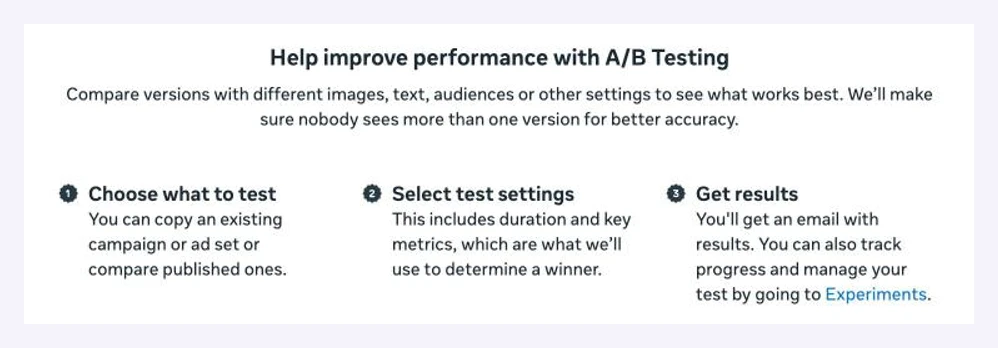
Creative testing in the ad editor. When you edit an ad, a Creative testing section sits right after the ad creative. Meta describes it as a way to "compare up to 7 different versions of your creative in a test that helps ensure delivery to new test ads."
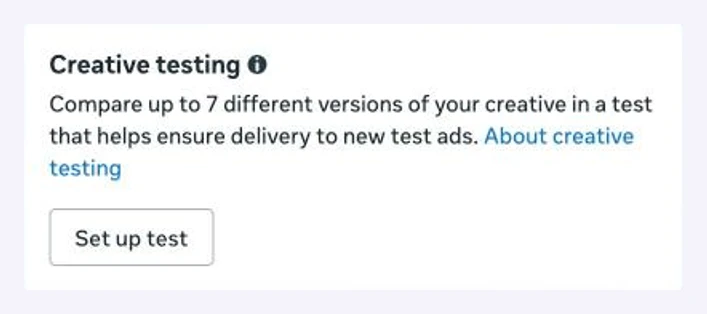
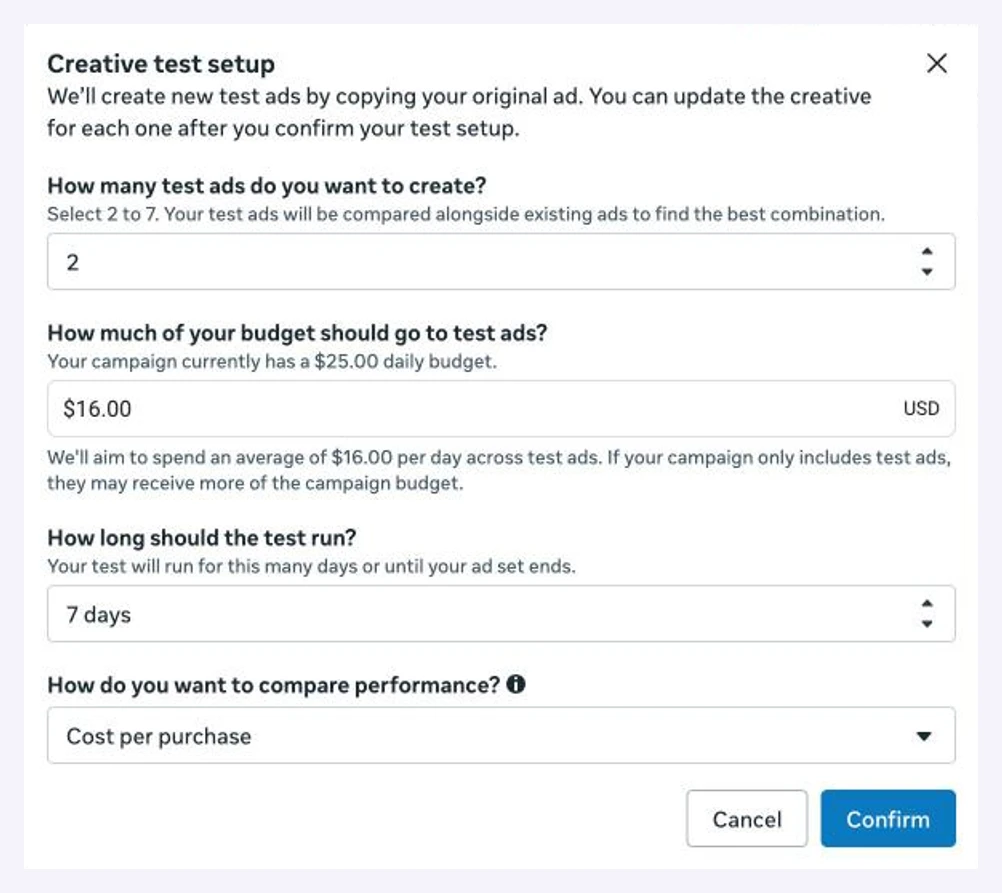
Clicking Set up test asks four things. You choose 2 to 7 test ads, which Meta creates by copying the ad you are editing, so the original ad is not part of the test. You set how much of the daily budget goes to the test ads, how many days it runs (7 by default), and the metric that decides the winner. Practitioners who have documented it, including Jon Loomer and Search Engine Journal, add that Meta recommends putting no more than 20% of your budget into the test when the ad set has other ads, and that the campaign must use the Highest Volume bid strategy. Results appear in Experiments.
Several ads in one ad set. This is what most stores do, and it is fine for running ads. It is not a test. Meta's delivery decides how to split spend between the ads, which is exactly why the creative testing tool exists to spread spend evenly instead. Meta's own guidance says it does not recommend testing informally, for example by turning ad sets on and off, because it "can lead to inefficient ad delivery and unreliable test results."
Step 3: Set a budget that can produce an answer
Meta's learning phase documentation says an ad set usually exits learning "after about 50 results in the week after the ad set's last significant edit." Until then, results are less stable and cost per result is usually higher. Its A/B testing best practices add that the test needs a budget "that will produce enough results to confidently determine a winning strategy."
An A/B test splits the audience and the budget between the versions, so each version has to collect its own results. The target applies to every version, not to the test as a whole, so the numbers below are per version. Work backwards from your cost per purchase:
| Cost per purchase | 50 purchases a week | Per day |
|---|---|---|
| $20 | $1,000 | about $143 |
| $38.99 (ecommerce median) | about $1,950 | about $279 |
| $50 | $2,500 | about $357 |
The $38.99 figure is the median cost per purchase across more than 40,000 brands in Triple Whale's Meta benchmarks for August 2025 to July 2026. Your own category may sit well above or below it.
Meta gives you a second check while you set the test up. When you create an A/B test by duplicating an ad, Ads Manager shows an estimated power next to the budget: the likelihood of a statistically significant result with that budget and schedule. Meta recommends at least 80%. If the number is lower, add budget, add days or test fewer versions.
If your budget cannot reach that, you have three options:
- Test fewer things at once. Two concepts, not five. Meta also advises against high ad volumes, because the system learns less about each ad when there are many.
- Optimize for an earlier event, such as add to cart, which happens more often. You get an answer sooner, but it is an answer about carts, not purchases.
- Run the test longer. A/B tests can run up to 30 days, which gives a smaller budget time to collect results.
Step 4: Keep the test clean
A good test can still be spoiled by how it runs. Meta's guidance gives four rules:
- Run at least 7 days. Meta recommends a minimum of 7 days and allows up to 30. If your customers usually take longer than a week to buy, run longer. Meta's own example is 10 days.
- Do not edit during the test. Edits to the ad, ad set or campaign during learning reset it.
- Use an audience that is large enough and not in use elsewhere. Meta says the test audience should not be used by any other campaign at the same time, because overlap contaminates the result.
- Keep the budgets equal. Different budgets make the comparison unfair.
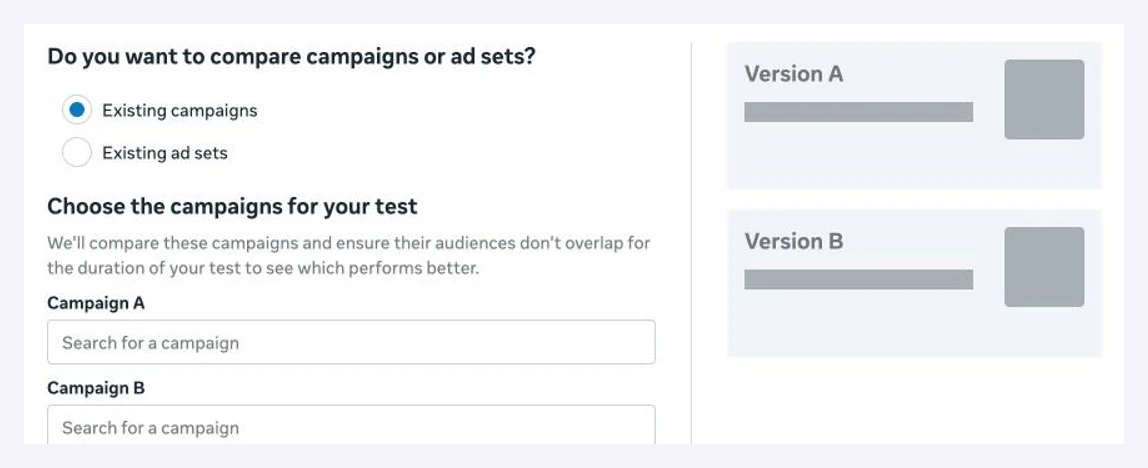
When you compare campaigns you already run, Ads Manager says it will keep their audiences from overlapping for the length of the test. That covers the versions inside the test. It does not stop another campaign outside the test from reaching the same people, which is why the audience rule above still matters.
There is one more limit that no setting removes completely. Researchers Michael Braun and Eric Schwartz showed in the Journal of Marketing that ad platforms deliver each version to a different, optimized mix of people. A "winning" ad can win because it was shown to people more likely to respond, not because the creative was better. A 2025 study by five researchers, most of them at Meta, measured this across 181,890 Meta A/B tests: a quarter of the audience comparisons came out significantly different between the groups that saw each version, against about 5% you would expect by chance. Meta's Lift tests, which use randomized holdouts, showed no meaningful imbalance.
The same study found ways to reduce the gap. Keep the objective, audience, budget, bidding, schedule and placements identical across versions, and vary only the creative. It was smallest with manual placements, static images and a frequency close to one impression per person. A quick practical check: open the age and gender breakdown of the result. If one version reached a very different mix of people, read the result with caution.
Step 5: Read the result
Meta chooses the winner of an A/B test by comparing cost per result, where the result is the event you chose, such as a purchase. It simulates the possible outcomes tens of thousands of times and reports how often the winner would win again as a confidence percentage. You can also add a holdout to compare cost per incremental purchase, which is the closest you will get to the true effect of the ad.
Three things to keep in mind when you read it:
- A winner can still be expensive. Meta notes that a winning campaign can have a higher cost when the test was too short, had too few results, or did not follow its best practices for length.
- CTR is not the judge. In Triple Whale's data, health and wellness brands have the highest median CTR, 3.02%, and the lowest ROAS, 1.44. Clicks are the easiest number to win. Purchases are the one that pays.
- Compare to your category, not to a single number. A cost per purchase of $45 is good in home and garden, where the median is $47.93, and poor in lifestyle and boutique, where it is $31.16. The full category table is in my best performing Meta ad creatives post.
If the winning ad gets clicks and few sales, the creative may not be the problem at all. We go through where to look in why a store gets traffic but no sales, and the page itself has to deliver what the ad promised: a demo or an offer that is missing from the product page loses the click.
Step 6: Iterate on the winner
Meta's tips for improving A/B tests describe what to test next, and they map well onto creative work:
- Test a different part of the creative. If you tested the image, test the headline or the text next.
- Test within the winning format. If a video beat a single image, test two videos against each other next, to learn what works within video.
- Repeat for another objective. A creative that won on purchases may not win on traffic, so retest before reusing it.
For variants of a winning image, you do not need a new shoot each time. AI product images can give you the same product in a new setting or crop, so the variable stays the image and everything else holds still. If you are deciding between a lifestyle scene and a plain shot, I compared what long-running ads show in what a Meta ad image should show.
Keep a log. It is the difference between testing and guessing twice.
Here is what two weeks of it might look like for the headphones above. The numbers are an example:
| Week | Hypothesis | Versions | Cost per purchase | Result | Next |
|---|---|---|---|---|---|
| 1 | An offer banner beats the lifestyle photo | Offer vs lifestyle | $38 vs $46 | Offer wins, 91% confidence | Test offer headlines |
| 2 | Leading with the discount beats leading with the product | Headlines A, B, C | $39, $36, $41 | B, the product-first one, is ahead at 78% confidence | Too close to call: rerun B against A for 7 more days |
How many new creatives to launch
Meta and the data seem to point in opposite directions here. Meta advises against high ad volumes inside an ad set, because the system learns less about each ad. Motion's benchmark found that accounts launching more creatives found more winners. In the smallest tier, under $10,000 a month, the average account launched 2.8 creatives a week and the top quarter 4.8. Between $10,000 and $50,000, it was 4.1 against 8.0, and the top quarter found 0.5 winners a month against 0.2.
Both are true, and they fit together: keep the number of ads in any one test small, and keep a steady stream of new concepts coming week after week. Two or three concepts per test, and a new test once the last one has an answer, is a pace most stores can hold.
When to replace a winning ad
There is no official benchmark for creative fatigue. Meta does not publish one, and agency guides range from every week to every month. In my sample of 386 long-running ecommerce ads from Meta's Ad Library, static ads ran a median of 90 days and video 70, and 19% of static ads ran past 180 days. A good ad can last months. Replace it when frequency rises and cost per purchase gets worse together, not on a calendar.
A first test for a small store
Here is how week 1 of that log would be set up, for a store selling the headphones with a cost per purchase around $40.
- Hypothesis: "An offer-first banner will get a lower cost per purchase than our current lifestyle photo."
- Versions: the current lifestyle ad and an offer banner, with the same product, the same ad text and the same 20% offer.
- Method: a Meta A/B test with the creative as the only variable, equal budgets and the same audience.
- Budget: about $2,000 a week for each version, $4,000 in total, which at $40 per purchase gets each one close to 50 purchases. If that is too much, optimize for add to cart instead and say so in the log.
- Length: 7 days minimum, no edits.
- Read: cost per purchase and Meta's confidence percentage, then the age and gender breakdown.
- Next: if the banner wins, test two banner variants with different headlines.
Mistakes to avoid
- Turning ads on and off and calling it a test.
- Changing more than one thing between versions.
- Editing the ad set in the first days because the numbers look bad.
- Stopping after two days because one version is ahead.
- Picking the winner on CTR or cost per click.
- Using the test audience in another campaign at the same time.
- Treating one result as permanent, instead of the best ad to run next.
Meta ad creative testing FAQ
How do I test ad creatives on Meta?
Write a hypothesis, change one variable, and use Meta's A/B test or the creative testing tool instead of putting several ads in one ad set. Give the test a budget for about 50 results a week, run it at least 7 days without edits, and pick the winner on cost per result.
How long should a Meta creative test run?
Meta recommends a minimum of 7 days and allows up to 30. Run longer if your customers usually take more than a week to buy.
How much budget do I need to test Meta ads?
Enough for about 50 results a week for each version, which is when Meta says learning usually ends. At the ecommerce median cost per purchase of $38.99, that is around $1,950 a week, or about $279 a day, per version.
How many ads should I test at once?
Two or three. Meta advises against high ad volumes, even though its creative testing tool takes up to 7. Fewer versions give each one more results.
Can I test creatives by putting several ads in one ad set?
You can run them that way, but it is not a test. Meta's delivery decides how spend is split between the ads, and Meta does not recommend informal testing because it leads to unreliable results.
Are Meta A/B test results always reliable?
Not completely. Research including Meta's own researchers shows that A/B tests can show each version to a different mix of people. Keep every setting identical except the creative, check the age and gender breakdown, and treat the winner as the best ad to run next.
Should I judge a creative test on CTR?
No. Meta picks the winner on cost per result, and high CTR does not mean sales. In Triple Whale's data, the category with the highest CTR also has the lowest ROAS.